
Creating Safe Retail Environments: How ProdataKey Secures Retail Operations


Retail environments are dynamic, fast-paced spaces where security mechanisms, customer experience, and business operations must live in a balance. From small storefronts to large multi-location enterprises, retailers face increasing pressure to protect their assets, customers, and employees while maintaining a welcoming and accessible atmosphere.
In order to strike this balance, solutions like flexible and data-rich access control can be implemented. The following white paper dives into the security needs of retail facilities, and explores the various solutions that ProdataKey (PDK) provides through its cloud-based access control technologies.
What are Retail Facilities?
Retail facilities are physical spaces where goods and/or services are sold to customers. These spaces can vary significantly in size and complexity, ranging from small independent stores to multi-location chain operations. Typically, retail spaces are high-traffic environments functioning around set hours of operation, and they commonly contain defined public and private areas — such as showroom floors, stockrooms, and offices.

Given these common characteristics, retailers must create a balance between an environment that welcomes customers and an environment that is capable of keeping visitors, staff, goods, and property safe at all times. That’s where PDK comes in.
Security Threats to Retail
Retailers face a wide and ever-expanding array of security threats — directly impacting profitability as well as employee safety, retailer reputation, and customer loyalty and experience. Understanding these threats is the first step in developing an effective security strategy for any retail space.
External Theft and Violence
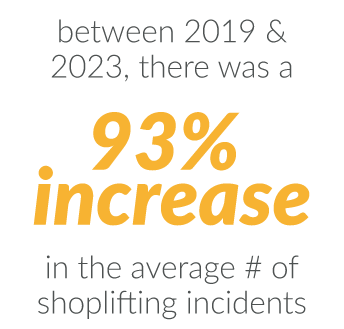
External theft, often referred to as shoplifting, is a persistent challenge for retail operations. Recent research from the National Retail Federation (NRF) reveals the sheer scale of this issue, with a concerning 93% increase in the average number of shoplifting accidents between 2019 and 2023. Not only is shoplifting on the rise, but its monetary impact is worsening — with the NRF 2024 Impact of Retail Theft & Violence report revealing a 90% increase in dollar loss due to shoplifting. Research from the Council on Criminal Justice (CCJ) backs up these concerning claims, with their 2023 analysis of shoplifting trends identifying the median value of shoplifted goods rising from $75 in 2019 to $100 in 2021.
In their 2023 Retail Security Survey, Appriss Retail reported that shoplifting incidents have led to a troublesome increase in inventory shrinkage, growing from 1.4% in 2016 to 1.6% in 2022. While that may seem like a very small shift, when taken as a percentage of total retail sales, a 1.6% product shrinkage represents over $111 billion in losses for retailers.
Often tied to instances of external theft are threats of violence — another notable security concern for staff and patrons alike. When surveying over 170 retail brands across the United States, Appriss Retail found that 88% of respondents reported that shoplifters have become somewhat or much more aggressive and violent than the year prior. In that same time frame, retailers reported a 35% increase in violent shoplifting incidents.

However, these trends are not uniform across all regions. Some metropolitan areas have experienced sharp increases in retail theft and violence, while others have seen notable declines. For example, the CCJ reported that places like New York City and Los Angeles saw shoplifting increases of over 60% in recent years — while cities like St. Paul and St. Petersburg saw decreases between 65–78%. Therefore, while external theft remains a looming threat for retail operations, it’s imperative that businesses pay attention to their specific environment and how that may shape the security and operational threats they face.
Internal Theft
While external theft garners significant attention, internal theft remains a substantial and often underestimated risk. Employees typically have greater knowledge of store operations and access to sensitive areas, making internal incidents potentially more damaging. On average, internal theft investigations result in losses of approximately $2,180 per investigation, according to Appriss Retail.

These incidents can be particularly difficult to detect and prevent without proper oversight. Old-fashioned security measures and operational tracking may not provide sufficient visibility into who accessed certain areas or resources, and at what time. To combat this, intuitive access control and monitoring systems can be implemented, generating detailed audit trails and reports of employee activity. This not only helps to appropriately address incidents after they have occurred, but it disincentivizes internal theft in the first place.
Property Damage
In addition to theft and threats of violence, retailers must also navigate the threat of property damage. Whether intentional or accidental, property damage significantly threatens the wellbeing of life and property in retail spaces, and can detract from a retailer’s positive reputation.

Data in the FBI Crime Data Explorer reveals the categories of retailers that have faced the brunt of property damage in recent years. Restaurants have emerged as the biggest victim of retail property damage in the United States, with an estimated 23,136 incidents in 2025 alone. Shortly behind restaurants are specialty stores — such as bookstores, cosmetics stores, furniture stores, sporting goods stores, and more — which saw 19,949 instances of property damage in 2025.
ProdataKey’s Solutions for Retail
To address the widespread security challenges in retail, ProdataKey offers a comprehensive cloud-based access control solution designed for reliability and ease of use around the clock. PDK’s solutions empower retailers to take control of their security while simultaneously streamlining operations — even for complex businesses spanning multiple locations.
Automatic Schedules
Retail operations often involve complex schedules, including defined store hours, shift rotations, and seasonal/holiday adjustments. Manually managing access for these complex environments can be error-prone and time-consuming. Luckily, PDK’s automatic scheduling capabilities simplify this process by allowing administrators to define access permissions based on time and day.

For example, the owner of a business open from 9AM to 5PM can set up an access schedule in PDK.io, causing the doors to automatically lock and unlock at those specific times. And for increased security, administrators can also apply a first-person-in rule. In this case, a door will remain locked until someone with the proper permissions opens it, after which the door will remain unlocked until the end of the specified auto open schedule, when the locks will automatically re-engage.
Automatic scheduling not only enhances security but also improves operational efficiency, since staff no longer need to rely on manual processes to gain access, and managers can focus on higher-value needs.
Custom Access Rules
Retail environments require precise control over who can access specific areas. To address those needs, PDK allows administrators to create highly customizable access rules tailored to each role, location, and operational need.

For example, a PDK.io Group of ‘Store Associates’ can be programmed, allowing members of that group to access sales floors and break rooms during specified periods, but restricting access to more sensitive cash offices or inventory storage spaces. Meanwhile, Store Managers may be given broader access to all areas of a space at any given time, based on the needs of their role.

Custom access rules ensure that individuals only have access to the areas necessary for their responsibilities. This principle of least privilege reduces the risk of both internal and external incidents. Furthermore, access rules can be updated at any given time in PDK.io. In the case that an employee leaves the organization or if they lose a physical credential, their access can be quickly revoked — reducing the risk of potential vulnerabilities and theft.
Cloud-Based Integrations
Access control systems are the most effective when used in tandem with other security technologies — that’s why ProdataKey excitedly integrates with various manufacturers, from intrusion detection platforms to employee management systems. Video management systems (VMS), in particular, are a powerful tool for retail spaces when integrated with access control.

Integrated video surveillance allows access events — such as denied or forced entries — to be paired directly with corresponding video footage. Instead of manually searching through hours of recordings, security teams can instantly view video clips tied to specific access activities. This dramatically improves both efficiency and accuracy when reviewing incidents.
A strong example of this type of integration is the partnership between PDK and Solink, bridging the gap between access control, surveillance, and point-of-sale (POS) systems. This integration allows for synchronized visual and access context, advanced filtering and searching, and AI-driven operational insights — all allowing retailers to take their security to the next level.

PDK: The Smart Approach to Retail Security
Retail security is more complex than ever, with evolving threats ranging from organized external theft and acts of violence to sophisticated internal fraud and property damage. Recognizing these threats, retailers must maintain welcoming, accessible environments for customers while simultaneously ensuring the safety of employees and assets.
Access control from ProdataKey serves as a critical tool in achieving this balance. By providing granular control over who can access specific areas and when, PDK helps retailers to reduce risk, improve accountability, and streamline operations. Altogether, this allows retailers to deliver a smarter, smoother, and safer experience for customers and staff alike.

ProdataKey (PDK) is a team of security integrators with decades of hands-on, in-the-field experience. PDK believes that the best technology is created by professionals who know what it takes to secure a facility properly and provide the end-user with a solution that instills confidence and safety.
PDK is passionate about creating technology to enhance the security, safety, and overall experience of both the professionals installing electronic access control and those that live with and use the system. PDK continues to create technology every day to enhance its products and the products of its technology partners.


