
Securing the Public Sector: ProdataKey's Solutions for Government and Municipal Facilities


Government and municipal facilities exist to serve the public and provide critical infrastructure and civic services. As spaces that exist to serve the public, these facilities need to maintain a welcoming environment, while also remaining as secure as possible in order to protect the people, assets, and information within these spaces.
As threats against public institutions increase in frequency and sophistication, access control has emerged as a foundational element of modern government security. The following white paper dives into the security needs of government and municipal facilities, and explores the various solutions that ProdataKey (PDK) provides through its cloud-based access control technologies.
What are Government and Municipal Buildings?
Government and municipal buildings encompass a wide spectrum of facilities that support public administration, safety, and infrastructure. These include city halls, courthouses, embassies, state capitols, military bases, fire stations, police stations, correctional facilities, public transportation hubs, and more. Each of these environments serves a distinct purpose, yet all share a common goal: protecting people and critical operations while remaining accessible to the public they serve.

These buildings are home to sensitive materials, including financial data, legal records, evidence, weapons, or secure IT systems. They also employ large and varied workforces, ranging from elected officials and administrators to first responders, law enforcement officers, and corrections staff. Managing access across these varied user groups requires more than physical keys or standalone systems. It demands a centralized, intelligent approach to access control that can adapt to different roles, schedules, and security levels without disrupting daily operations.
Security Considerations for Government Facilities
Municipal and government facilities face a series of complex and evolving threats. Their public-facing nature makes them inherently vulnerable, while their symbolic and functional importance can make them targets for criminal activity or violence. Therefore, effective security planning must address both routine risks and extraordinary threats, with access control serving as a critical line of defense.
Preventing Theft and Trespassing
Theft and trespassing remain persistent challenges for public buildings. National crime data from the FBI Crime Data Explorer shows that burglaries and thefts in government and public facilities have increased over the past decade, with a notable rise following 2019. These incidents range from opportunistic thefts of equipment or personal property to deliberate intrusions aimed at accessing restricted areas.

Beyond the immediate financial impact of stolen resources, unauthorized access can have far-reaching consequences. Government facilities often store sensitive information, including confidential records, financial data, and personally identifiable information. This information has become a notable target in recent years, with over a thousand documented cases of unauthorized access to sensitive government IT systems and data in 2023 alone, according to the 2023 Performance and Accountability Report from the United States Government Accountability Office.
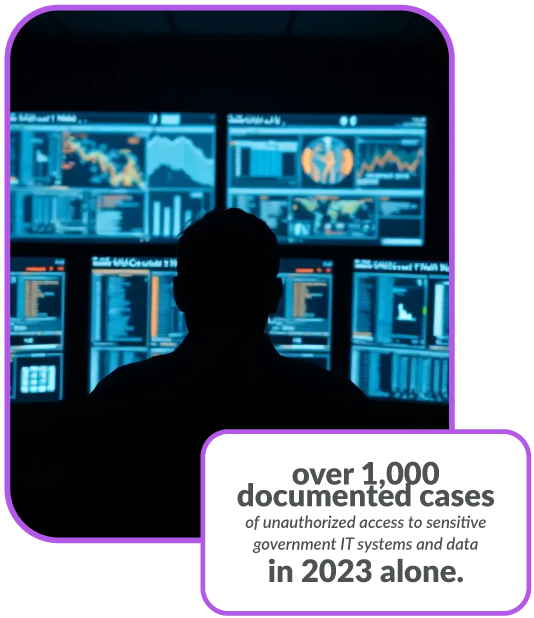
While these incidents are often discussed in the context of cybersecurity, physical access is frequently a contributing factor to digital security breaches. When individuals can enter secure areas without proper authorization, digital systems and data become far more vulnerable.
Modern access control systems help mitigate these risks by enforcing clear boundaries between public, semi-public, and restricted spaces. By ensuring that only authorized individuals can enter sensitive areas, agencies reduce the likelihood of theft, data exposure, and operational disruptions.
Navigating Threats of Violence
In addition to property crime, government facilities must contend with an increasing number of violent threats. Acts of terrorism, civil unrest, and targeted intimidation of public servants have become more common, placing added strain on security infrastructure. In 2022, the National Center for State Courts reported 57 bomb threats targeting courthouses across the United States. And between the years of 2015 and 2025, an estimated 1,600 public servants received some form of violent threat, according to a report from the The Impact Project. These threats place government facilities in a vulnerable position, requiring serious security action.

These realities underscore the need for prevention and rapid response—and access control plays a vital role in both. By limiting access to critical areas, agencies can reduce opportunities for attackers to reach high-risk targets. In emergency situations, access control systems can support lockdown procedures, restrict movement, and help direct occupants to safety. When integrated with monitoring and alerting tools, access control becomes part of a broader situational awareness strategy that enables faster, more coordinated responses to emerging threats.
A visible, well-managed access control system signals preparedness and professionalism. For employees and visitors alike, this can foster a sense of safety and confidence, even in environments that must remain open and welcoming.
Achieving Accreditation
Accreditation is an important consideration for many government and municipal facilities. While often voluntary, accreditation demonstrates a commitment to best practices, accountability, and continuous improvement. It can also reduce liability, improve operational consistency, and enhance public trust.

Police departments commonly pursue accreditation through the Commission on Accreditation for Law Enforcement Agencies (CALEA). Standards associated with this process emphasize effective management of high-liability spaces and rigorous evidence handling procedures. Restricting access to evidence rooms, armories, and investigative spaces helps preserve the chain of custody and protect the integrity of cases. Additionally, detailed access logs provide objective documentation that policies are being followed and that accountability is enforced.

Correctional facilities face similarly demanding standards. Accreditation frameworks promoted by the American Correctional Association (ACA) focus on safety, security, order, and effective administration. In these environments, access control is not only about protecting assets but also about managing movement, preventing contraband, and ensuring the safety of staff and inmates. Systems that can enforce role-based permissions and document every access event support compliance while improving daily operations.
Ultimately, access control plays a pivotal role in achieving accreditation for government facilities across the board. With reliable security protocols and audit logs, these facilities can show that they are operating with professionalism.
ProdataKey’s Solutions for Government
Modern government security requires solutions that are dependable, scalable, and adaptable. ProdataKey delivers access control technology designed to meet the operational and regulatory demands of government and municipal facilities while remaining intuitive and efficient for administrators and end users.
Reliable Access Control
At the core of ProdataKey’s offering is reliable access control for both perimeter and interior doors. This approach prevents unauthorized individuals from entering the facility while also ensuring that access inside the building is carefully administered, with specific areas available only to users who have the appropriate permission levels.

Role-based permissions are a core feature, enabling agencies to directly align access permissions with job functions. This reduces the risk of over-privileged access and simplifies changes when employees are promoted, reassigned, or separated. In environments where staffing levels and responsibilities can change rapidly, this flexibility is essential.

Additionally, government agencies can manage access across single buildings or a large array of facilities from a centralized platform. This centralized approach ensures consistency while allowing for local customization based on facility type, risk profile, or operational needs.
Reliability is especially critical for public-sector operations that function around the clock. ProdataKey’s architecture is designed to support continuous operation, helping ensure that access control remains functional even during network disruptions or emergency situations. For facilities such as police stations, emergency operations centers, and correctional institutions, this resilience is not optional; it is mission-critical.
Detailed Reporting
Visibility and accountability are key components of effective government security. ProdataKey provides detailed reporting capabilities that support both real-time monitoring and long-term analysis.

The Live Events page allows security personnel to observe access activity as it occurs, enabling rapid response to unusual behavior or incidents. Historical reporting is equally important. PDK supports long-term data retention, with access records available for up to five years depending on the selected reporting plan. These Reports can include precise timestamps, user identities, credential information, and access outcomes. These details are invaluable for investigations, audits, and accreditation reviews. Reporting also allows agencies to identify trends, evaluate policy effectiveness, and make data-driven improvements to their security protocols.
Integrated Solutions
Access control is most powerful when it operates as part of an integrated security ecosystem. ProdataKey is designed to integrate seamlessly with complementary systems such as video surveillance, emergency response tools, visitor management platforms, and employee management systems.

By linking access events with video footage, agencies gain valuable context that enhances incident review and threat assessment. Integration with emergency response systems enables coordinated actions, such as triggering alerts or lockdowns based on specific access conditions. Visitor management integrations support secure, efficient handling of public traffic, while employee management integrations streamline credential lifecycle processes and reduces administrative overhead.
Together, these integrations transform access control from a standalone function into a central component of a comprehensive, intelligent security strategy.
Building Safer and Smarter Government Facilities with PDK
Government and municipal facilities face a unique set of security challenges, driven by their public-facing nature, their responsibility to protect sensitive assets, and their obligation to maintain trust and transparency. Rising rates of theft, unauthorized access, and violent threats make it clear that traditional lock-and-key security approaches are no longer sufficient.
Modern access control systems provide a critical foundation for addressing these challenges. When implemented effectively, they help prevent crime, support rapid response to threats, and enable agencies to meet demanding accreditation and compliance requirements. Just as importantly, they reinforce accountability and professionalism, strengthening public confidence in government institutions.
ProdataKey’s access control solutions are purpose-built to support these goals. Through reliable control, detailed reporting, and seamless integration, PDK helps government agencies protect their people, facilities, and information while continuing to serve the public effectively.

ProdataKey (PDK) is a team of security integrators with decades of hands-on, in-the-field experience. PDK believes that the best technology is created by professionals who know what it takes to secure a facility properly and provide the end-user with a solution that instills confidence and safety.
PDK is passionate about creating technology to enhance the security, safety, and overall experience of both the professionals installing electronic access control and those that live with and use the system. PDK continues to create technology every day to enhance its products and the products of its technology partners.


